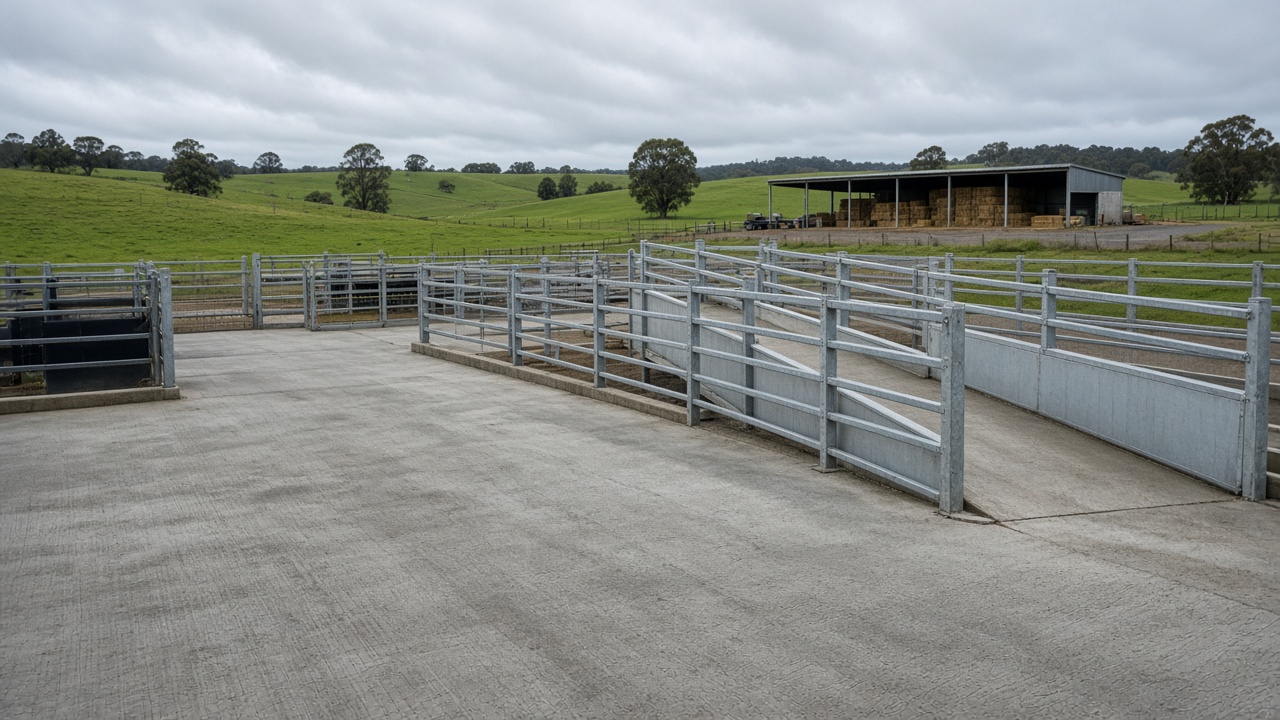
Farm, stable and cattle yard concrete near Lang Lang
Cattle yard floors, loading ramps, feed pads, dairy and calf shed floors, stables, wash bays, trough pads and farm entrances for the beef, dairy and horse properties around Lang Lang.
Email: info@langlangconcreting.com.au
Concrete for working farms
The country around Lang Lang is still farming country. Beef cattle graze the flats toward Western Port, dairy farms run east into the hills toward Nyora and Poowong, and horse properties and studs are found on almost every road out of town. Farm concrete works harder than almost any other concrete: it carries heavy machinery and stock, gets wet and dirty every day, and has to stay safe underfoot for animals and people.
We pour farm concrete across the Lang Lang district, including cattle yard floors, loading ramps and race floors, dairy yards and feed pads, calf and hay shed floors, stables, wash bays and feed rooms, trough pads, gateways and farm entrances.
Cattle yards and loading ramps
Cattle yards with concrete floors are easier to clean, safer for stock and handlers, and stop the yard turning into a bog in winter. We pour yard floors, the floor of the race and crush area, and loading ramps, working around existing or new steel yards. The finish must give cattle good footing, so we use a deep broom, grooved or patterned finish depending on the area. Falls are designed so water and manure move toward a drain or collection point, and the slab is thick enough for tractors and stock trucks.
Loading ramps need careful design, with a safe grade, cleats or grooves for footing, and a solid connection to the yard floor. If your yards are being built by a steel yard supplier, we coordinate with them on post positions and levels.
Feed pads and dairy yards
Feed pads and dairy yards carry cows in large numbers every day, along with tractors and feed-out wagons. They need to be strong, durable and drained properly. We design falls toward the effluent system, use a grooved finish for footing, and size the slab and steel for the loads. If your processor, an engineer or an effluent designer has specified requirements, send them to us and we will build to them.
Stables, wash bays and horse areas
Horse properties around Lang Lang need stable floors, wash bays, feed rooms, tack rooms and float parking. Stable floors need a textured surface for footing and falls so urine and wash water drain away. Wash bays need a grippy finish, a drain and enough room for the horse and handler. Feed and tack rooms need a dry, level floor. We also pour concrete pads beside stables for float and truck parking.
Trough pads and gateways
Some of the most useful farm concrete jobs are small. A concrete pad around a water trough stops the area turning to mud, protects the trough and makes it easier for stock to drink. A concrete gateway in a wet paddock lets you move stock and machinery through in winter without bogging. We can pour several small pads on a single visit to make the trip worthwhile.
Hay sheds, machinery sheds and hardstands
Hay sheds need a dry floor or at least a dry apron, and machinery sheds need a strong floor that carries tractors and equipment. We pour shed floors to the supplier's engineering, with door aprons that keep water out. Hardstands beside sheds give you somewhere solid to park trucks, trailers and equipment, and a concrete area for refuelling or mixing chemicals keeps spills contained.
Ground on the farms
The ground around Lang Lang varies from deep sand to heavy clay and peaty former swamp. On farms, the challenge is often wet ground, especially in winter, and heavy loads. We remove soft and organic material, build a compacted crushed-rock base, and design falls and drainage so water does not soften the ground beneath the slab. We plan pours around the weather and the farm calendar, avoiding the wettest weeks where possible.
Access and the farm calendar
Farm jobs often involve long tracks, soft paddocks and limited access for concrete trucks and pumps. We look at access on the site visit and plan how concrete will reach the job, using a pump or line pump where needed. We work around calving, silage, hay and other busy periods, and keep disruption to a minimum.
Farm entrances
A concrete farm entrance stops the gateway turning to mud and keeps gravel off the road. Where there is a table drain, we install a culvert with concrete headwalls. Entrances off the South Gippsland Highway and Bass Highway may need state road authority consent, and other roads generally need council consent. Whatever approvals your job needs are listed on the written quote.
Chemical, fuel and wash-down areas
Farms around Lang Lang often need a dedicated area for mixing sprays, refuelling machinery or washing down equipment. A concrete pad with a raised edge or bund keeps spills contained, and falls direct wash water to a sump or a safe discharge point. We design these with your farm layout in mind, keeping them away from waterways and drains where possible.
Working with yard and shed suppliers
Many cattle yard and shed jobs involve a steel supplier as well as the concreter. We coordinate post positions, footing depths, levels and timing with them, so the steel goes up on concrete that suits it and nobody waits on anyone else.
Calf sheds and small animal areas
Calf sheds, sheep handling areas and poultry sheds benefit from a concrete floor that can be scraped and hosed. We pour these with a gentle fall to a drain or the open side of the shed, a finish that suits the animals, and a raised edge where bedding needs to be contained. On wet sites, raising the floor above the surrounding ground keeps the shed dry through winter.
Sand ridges, swamp clay and Cardinia Shire rules
Lang Lang sits where two very different kinds of ground meet. East and north-east of town are the sand ridges that supply much of Melbourne's building sand, where blocks often have deep, free-draining sand. West and north-west, toward Western Port and the drained Koo Wee Rup swamp, the soil turns to grey clay, silt and in places peat, with water close to the surface through winter. Plenty of blocks have a bit of both.
On sand, the work is about compaction and holding the edges so the sand cannot wash out from under the slab. On clay and swamp ground, it is about digging out the soft and organic layers, building a compacted crushed-rock base and setting levels and falls so water leaves the slab on flat land. Pouring within the property line is normally permit-free. Anything out at the street, such as the crossover, the nature strip or a public footpath, is road reserve and usually needs Cardinia Shire to sign off, highway frontages may add the state road authority, and a house, garage or large shed slab needs a building permit plus engineering. Your quote lists whichever of these apply.
What goes into a Lang Lang concreting quote
Our quotes are written down and broken into lines you can check. Each one lists the measured area, the removal of any old concrete or topsoil and where it goes, the excavation depth, the crushed-rock base, the slab thickness, the reinforcement, the finish and colour, the joint layout, any drains or pits and where they discharge, steps or edges, sealing, the crossover and any council, road authority or building permit steps. If a pump, a long barrow run or a soft paddock affects access, the quote says so.
You will not find a rate per square metre on this website. Around Lang Lang the ground changes from deep quarry sand to wet swamp clay within a few kilometres, and that changes the preparation more than the size of the job does. A free visit lets us see the block, the access and the drainage, and price what your job actually needs rather than a guess.
What you get with Lang Lang Concreting
Based in Lang Lang 3984
We start in town and work out to the Western Port, Bass Coast and South Gippsland towns we visit every week.
Sand, clay and swamp ground
We check what is under each block and prepare the base for it, rather than one depth for every job.
Free written quotes
Itemised quotes, no published rates and no charge for the visit or the paperwork.
Town, rural and farm
Estate driveways and house slabs through to stables, sheds and cattle yards, with permits named up front.
From first call to finished concrete
- 1
Make contact
Ring, email or send the form with photos of the area, the street or farm entrance and anything awkward about access.
- 2
Free visit
We measure, check levels, test what is under the surface, look at drainage and bring finish samples to see in daylight.
- 3
Itemised quote
A written quote listing base, thickness, steel, finish, joints, drains and any council or permit steps.
- 4
Prep and forms
Old concrete and soft ground come out, the base is compacted in layers, forms are set and steel goes in on chairs.
- 5
Pour day
The truck or pump delivers, the crew screeds and finishes, and the slab is shielded from wind, sun or rain as it cures.
- 6
Finish up
Joints are cut, forms stripped, rubbish removed, sealer applied if quoted, and you get written care notes.
Farm and Cattle Yard Concrete questions
Do you pour cattle yard floors around existing steel yards?
Yes. We work around existing posts and rails or coordinate with your yard supplier on new yards.
What finish is best for cattle?
A deep broom, grooved or patterned finish that gives good footing, with falls so water and manure drain away.
Can you pour several small trough pads in one visit?
Yes. Grouping small jobs together is efficient and makes the visit worthwhile.
Do you pour stable floors?
Yes, with a textured finish for footing and falls to a drain.
Where we work
Other concreting services
Talk to a Lang Lang concreter
Free site visits and itemised written quotes for jobs in Lang Lang 3984 and the Western Port towns around it. Nothing on this site is priced, because every block and its ground are different.