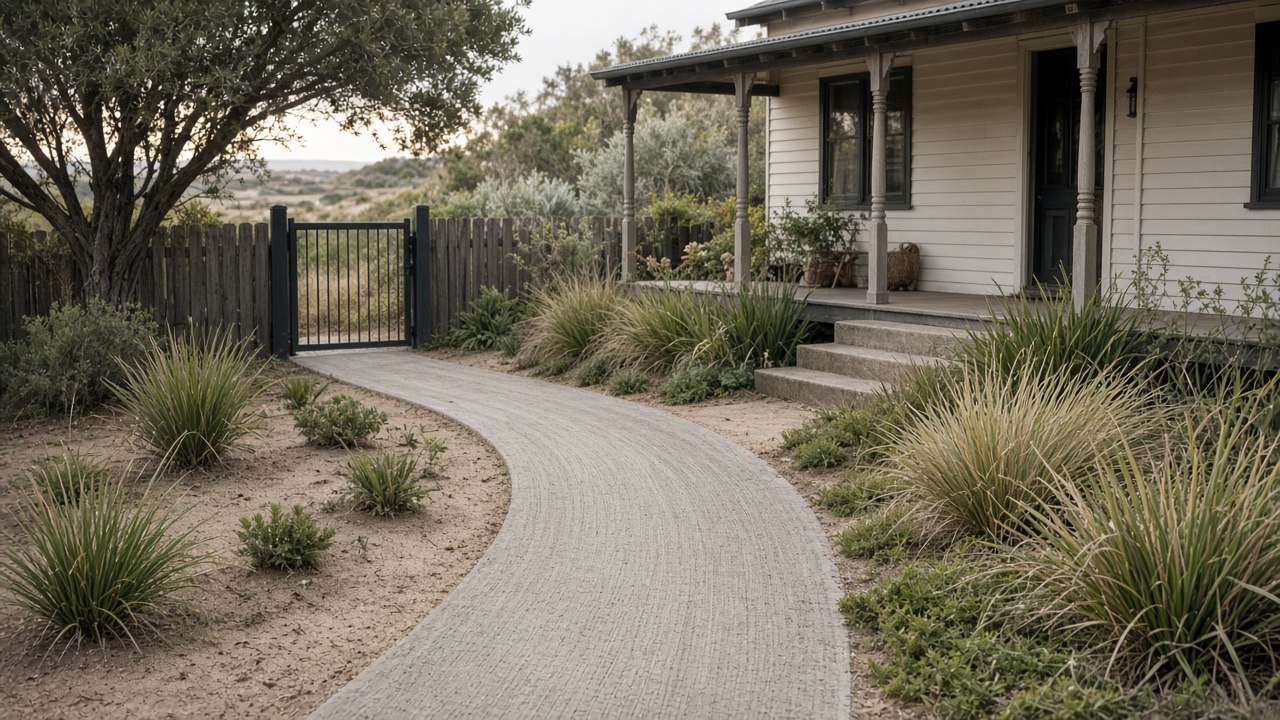
Concrete paths in Lang Lang
Front paths, side paths, garden paths and paths to the shed, clothesline and bins for Lang Lang homes, poured on a compacted base with neat edges, steps where needed and finishes that grip when wet.
Email: info@langlangconcreting.com.au
Paths that make a home work
Paths are easy to overlook, but they make a big difference to how a home works. A solid front path welcomes visitors. A side path keeps feet out of the mud on the way to the backyard. Paths to the clothesline, shed, bins, chook pen and vegie garden make everyday jobs easier, especially in winter when Lang Lang lawns turn soft and sandy yards track grit into the house.
We pour all kinds of paths around Lang Lang, from a short front path to long garden paths winding through a large backyard.
Planning the layout
A good path follows the way people actually walk. We look at where you come and go, where the bins live, how you get to the shed and clothesline, and where you want the path to lead. Paths can be straight and practical, or gently curved to soften a garden. We also plan the width: a main path to the front door or side gate should be wide enough for two people or a wheelie bin, while a garden path can be narrower.
Levels, falls and steps
Paths need falls so water runs off rather than pooling. Along the side of a house, the path should fall away from the walls toward a drain or garden. On sloping blocks, we design steps or ramps with consistent rises and treads, so the path is safe and comfortable to use. Where the path meets a doorway, we keep it below the floor level and any weep holes.
Side paths and drainage
Side paths beside a house are one of the most common jobs we do. They keep the area dry and clean, stop weeds and give easy access. But they must be designed carefully so water does not run toward the house or pool against the walls. We set falls away from the house, leave weep holes and vents clear, and connect to a drain if needed. On sandy blocks, a side path also helps stop sand being washed against the house.
Finishes for paths
Broom finish is the most practical choice for paths, because it grips well when wet. Exposed aggregate is also popular, especially when it matches the driveway. Coloured concrete and stencil patterns can add character to front paths and entries. On garden paths, a simple broom finish with neat edges often looks best.
Base and edges
Paths may be narrower than driveways, but they still need a proper base. We remove topsoil and soft material, compact the ground and build up a crushed-rock base. On Lang Lang's sandy ground, we pay particular attention to edges, because sand can wash away and leave the edge unsupported. Planting, edging or gravel along the sides helps hold the sand in place.
Joints
Paths need control joints at regular intervals to control cracking. We usually saw cut or tool joints at even spacings, which also gives the path a neat, finished look.
Access and small jobs
Paths are often in tight spaces, such as down the side of a house or through a narrow gate. We plan how concrete will reach the work area, often using wheelbarrows or a small pump, and protect gardens, fences and existing surfaces along the way. We are happy to quote small path jobs, and they can often be combined with other work.
Paths on farms and rural blocks
On rural properties, paths from the house to the shed, stables or garden make a big difference in winter. We can pour long paths in broom finish, and include steps or ramps where the ground changes level.
Accessible paths
If someone in the family uses a wheelchair, walker or pram, we can design paths with gentle grades, smooth transitions and wider widths to make access easier. Ramps can be included where needed.
Paths through sandy gardens
Many Lang Lang gardens, especially east of town, are sandy. Sand is easy to dig but tends to drift onto paths and wash away from their edges. We set paths slightly above the surrounding garden so sand is less likely to wash across them, compact the base and edges well, and suggest edging, mulch or low planting along the sides to hold everything in place.
Paths on wet clay
On clay blocks toward Western Port, paths can turn into the only dry ground in the yard during winter. We build a solid base, remove soft clay, and set falls so water runs off the path into the garden or a drain. Where a path crosses a low point, a small grated drain or a gap for water to pass under can stop puddles forming on one side.
Paths to the shed, stables and chook pen
On larger blocks, a path from the house to the shed, stables, chook pen or vegie garden is one of the most useful things you can add. In winter, it keeps boots out of the mud and makes daily jobs easier. We can pour long broom-finished paths economically and include a wider section near gates for barrows.
Matching the house and driveway
A path that matches the driveway in finish and colour ties the front of the property together. If you are not ready to do the driveway, we can pour the path now and note the mix and finish for later, so a future driveway can be matched as closely as possible.
Paths for bins and barrows
A path that carries wheelie bins every week, or barrows of mulch and feed, should be wide enough and smooth enough at transitions that wheels roll easily. We avoid lips at joints and set gentle ramps instead of single steps where wheels need to pass.
Sand ridges, swamp clay and Cardinia Shire rules
Lang Lang sits where two very different kinds of ground meet. East and north-east of town are the sand ridges that supply much of Melbourne's building sand, where blocks often have deep, free-draining sand. West and north-west, toward Western Port and the drained Koo Wee Rup swamp, the soil turns to grey clay, silt and in places peat, with water close to the surface through winter. Plenty of blocks have a bit of both.
On sand, the work is about compaction and holding the edges so the sand cannot wash out from under the slab. On clay and swamp ground, it is about digging out the soft and organic layers, building a compacted crushed-rock base and setting levels and falls so water leaves the slab on flat land. Pouring within the property line is normally permit-free. Anything out at the street, such as the crossover, the nature strip or a public footpath, is road reserve and usually needs Cardinia Shire to sign off, highway frontages may add the state road authority, and a house, garage or large shed slab needs a building permit plus engineering. Your quote lists whichever of these apply.
What goes into a Lang Lang concreting quote
Our quotes are written down and broken into lines you can check. Each one lists the measured area, the removal of any old concrete or topsoil and where it goes, the excavation depth, the crushed-rock base, the slab thickness, the reinforcement, the finish and colour, the joint layout, any drains or pits and where they discharge, steps or edges, sealing, the crossover and any council, road authority or building permit steps. If a pump, a long barrow run or a soft paddock affects access, the quote says so.
You will not find a rate per square metre on this website. Around Lang Lang the ground changes from deep quarry sand to wet swamp clay within a few kilometres, and that changes the preparation more than the size of the job does. A free visit lets us see the block, the access and the drainage, and price what your job actually needs rather than a guess.
What you get with Lang Lang Concreting
Based in Lang Lang 3984
We start in town and work out to the Western Port, Bass Coast and South Gippsland towns we visit every week.
Sand, clay and swamp ground
We check what is under each block and prepare the base for it, rather than one depth for every job.
Free written quotes
Itemised quotes, no published rates and no charge for the visit or the paperwork.
Town, rural and farm
Estate driveways and house slabs through to stables, sheds and cattle yards, with permits named up front.
From first call to finished concrete
- 1
Make contact
Ring, email or send the form with photos of the area, the street or farm entrance and anything awkward about access.
- 2
Free visit
We measure, check levels, test what is under the surface, look at drainage and bring finish samples to see in daylight.
- 3
Itemised quote
A written quote listing base, thickness, steel, finish, joints, drains and any council or permit steps.
- 4
Prep and forms
Old concrete and soft ground come out, the base is compacted in layers, forms are set and steel goes in on chairs.
- 5
Pour day
The truck or pump delivers, the crew screeds and finishes, and the slab is shielded from wind, sun or rain as it cures.
- 6
Finish up
Joints are cut, forms stripped, rubbish removed, sealer applied if quoted, and you get written care notes.
Concrete Paths questions
How wide should a side path be?
Wide enough to walk comfortably and wheel a bin, usually wider than a garden path. We plan the width with you on the visit.
Will a side path cause water problems against the house?
Not if it is designed properly. We set falls away from the house and keep weep holes and vents clear.
Do you do small path jobs?
Yes. We are happy to quote small jobs, and they can often be combined with other work.
Where we work
Other concreting services
Talk to a Lang Lang concreter
Free site visits and itemised written quotes for jobs in Lang Lang 3984 and the Western Port towns around it. Nothing on this site is priced, because every block and its ground are different.