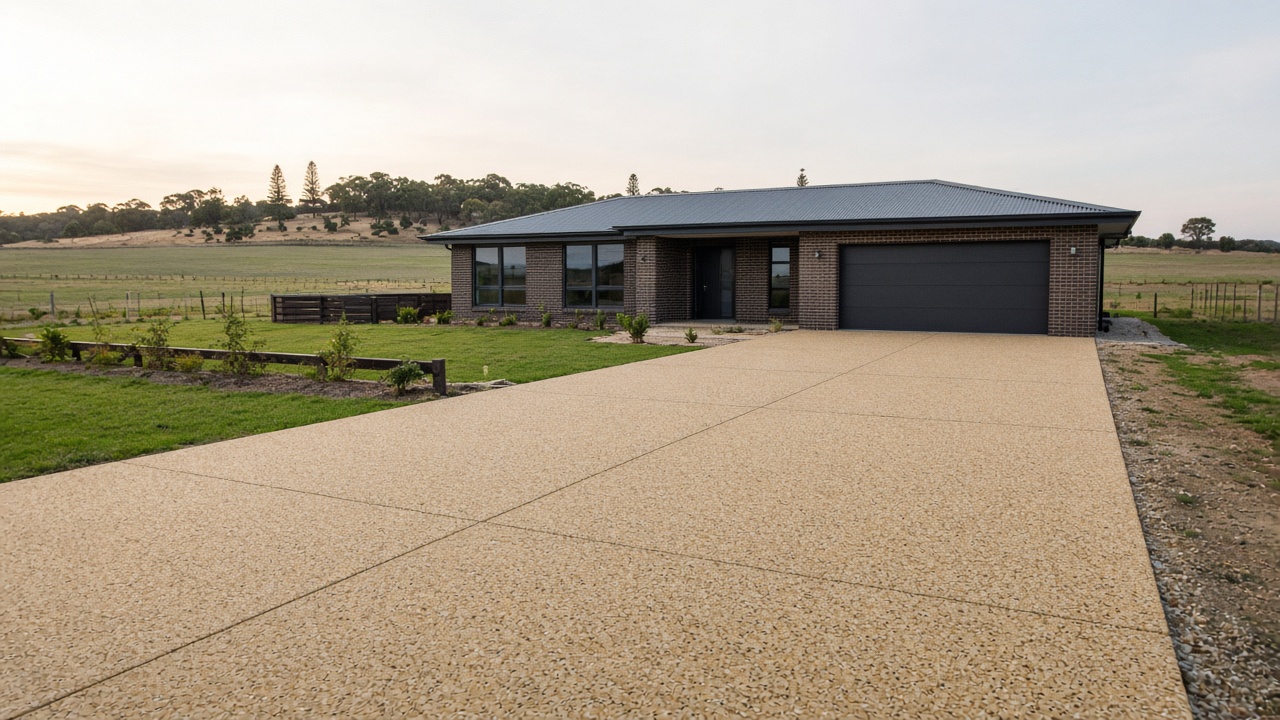
Concrete driveways on Lang Lang sand and clay: a practical guide
Lang Lang sits between deep sand ridges and the clay and peat of the old swamp, and much of it is flat. This guide explains what those conditions do to a concrete driveway, what we check on a visit, and how a driveway is prepared so it stays flat, dry and crack-free.
Email: info@langlangconcreting.com.au
Two kinds of ground, a few kilometres apart
Few towns have ground that changes as quickly as Lang Lang's. To the east and north-east, low ridges of fine sand run through the paddocks, and the sand quarries there supply a large share of the sand used in Melbourne's building industry. To the west and north-west, the land falls away to the flats beside Western Port and the drained Koo Wee Rup swamp, where the soil is grey clay and silt, sometimes with dark peat, and the water table sits close to the surface through winter.
In town, many blocks sit on a mix: sandy topsoil over clay, or sand in one corner and clay in another. Estate blocks may also contain fill placed during subdivision. A driveway that suits one of these conditions can fail on another, so the first step is always to find out what is there.
What we check on the first visit
We start by looking at the surface: where water sits after rain, whether the lawn is soft or firm, and whether there are signs of old fill such as rubble, mixed soil or uneven ground. Then we dig or probe a few test spots along the line of the driveway to see how deep the topsoil goes and what is underneath. We check the levels from the road to the garage, the height of the garage floor and the house slab, and where water can legally go. We look at access for the concrete truck or pump, the crossover and any trees or services near the work area.
Building a driveway on sand
Sand is a good foundation when it is dense and confined. Loose sand, though, settles under load, and sand at the edge of a slab can wash away in heavy rain or be dug out by rabbits or dogs, leaving the edge unsupported. So on sandy blocks we remove the topsoil, compact the sand thoroughly, and build a compacted crushed-rock base on top. We thicken the edges where wheels run, and we recommend edging, gravel or planting along the sides so the sand stays put. Because sand drains well, water is rarely trapped under the slab, but surface falls still matter so water runs off the driveway rather than across it.
Building a driveway on clay and swamp ground
Clay behaves very differently. It holds water, swells when wet and shrinks when dry, and soft wet clay compresses under load. Peat and organic soil keep compressing for years. On these blocks, we dig out the topsoil, peat and any soft clay until we reach firmer ground, then build up with crushed rock compacted in layers. On very soft ground, a geotextile fabric under the rock stops it pushing down into the clay. We plan the timing so the base is not built on saturated ground, and we cover or protect it if rain threatens before the pour.
Falls on flat land
The biggest design challenge in Lang Lang is not slope but the lack of it. On flat ground, water does not leave a driveway unless the concrete is shaped to move it. We design falls away from the house and garage, usually toward the street, a pit or a garden area, and we set the driveway level so the garage floor stays dry and the threshold is comfortable to drive over. Where the garage sits lower than the street, a grated drain across the driveway in front of the door catches water before it reaches the garage, and it must connect to a legal discharge point.
Steel, thickness and joints
The thickness of the slab and the steel inside it are chosen for the vehicles that will use it. A driveway for cars needs less than one for a loaded horse float, a caravan, a work truck or a delivery of landscaping supplies. Steel goes on bar chairs so it sits within the concrete. Control joints are saw cut at planned spacings so shrinkage cracks follow straight lines, and isolation joints let the driveway move independently of the house, the garage floor, the crossover and older concrete.
Finishes that suit sandy, dusty ground
Sand gets carried onto every driveway around Lang Lang, and in winter it comes as sandy mud. Exposed aggregate hides it well and grips when wet. Broom-finished plain concrete is practical and easy to clean. Coloured concrete in mid greys or earthy tones is more forgiving than very dark or very light colours. Smooth or highly sealed finishes can become slippery with a film of fine sand, so we suggest a textured finish or a slip-resistant sealer.
Long rural driveways
On lifestyle blocks and farms, driveways can be hundreds of metres long. Concreting the whole length is rarely necessary. The parts that matter most are the entrance off the road, where trucks turn and gravel gets dragged onto the bitumen, the area near the house and sheds, and any turning bays used by floats, trucks or tankers. The middle section can stay as well-maintained gravel. Where the entrance crosses a table drain, a culvert pipe with concrete headwalls keeps the drain flowing.
A checklist for comparing quotes
Does the quote say how deep the excavation goes and what happens to soft ground? Does it state the base material and depth, the slab thickness and the steel? Does it describe the falls and any drains, and where the water goes? Does it show the joint layout? Is the crossover covered, along with the council's consent? Are the finish and sealer named? When every one of those has an answer on paper, two quotes can be compared fairly and there is little room for nasty surprises.
Looking after the driveway
Keep vehicles off until the concrete has gained enough strength, usually around a week for cars and longer in cool weather or for heavy loads. Sweep or hose sand off regularly so it does not grind into the surface or a sealer. Keep grated drains clear. On sandy blocks, check the edges after heavy rain and fill any gaps so the slab stays supported. Reseal when water stops beading if the driveway is sealed.
Talk to a Lang Lang concreter
Free site visits and itemised written quotes for jobs in Lang Lang 3984 and the Western Port towns around it. Nothing on this site is priced, because every block and its ground are different.