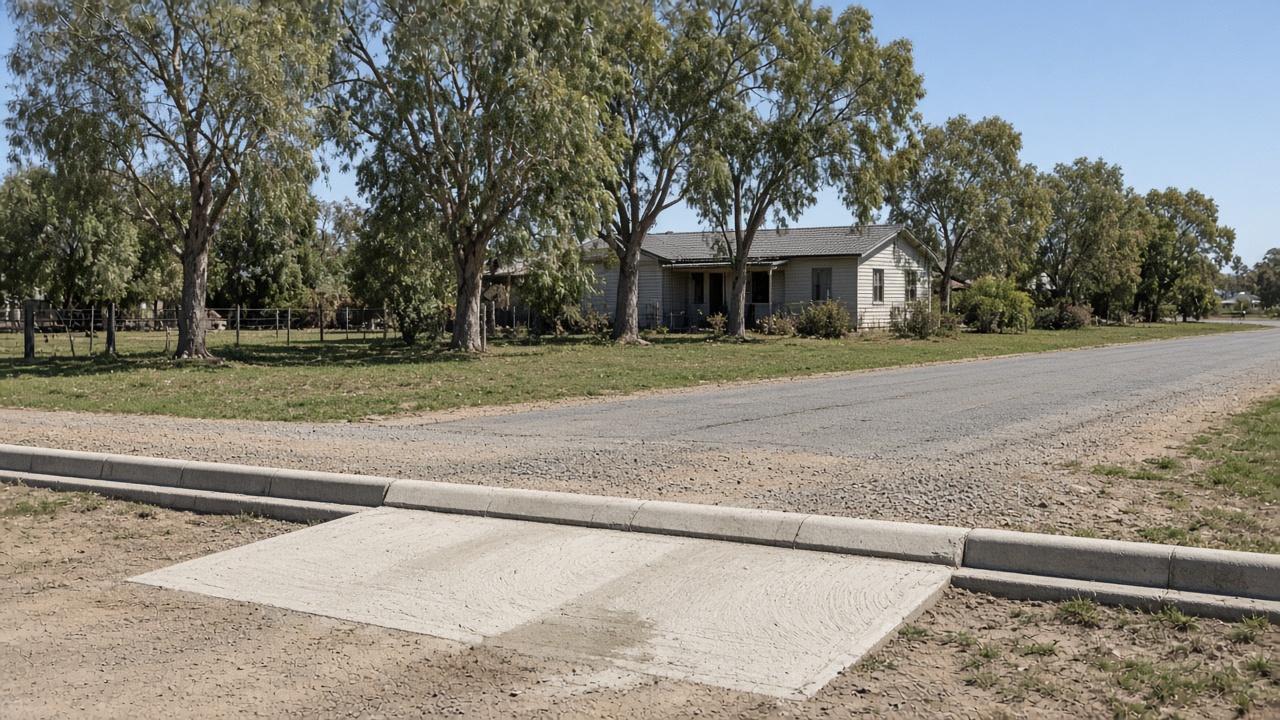
Vehicle crossovers in Lang Lang
New, replacement and widened vehicle crossovers in Lang Lang and nearby towns, built to council standards with the consent arranged, including rural entrances with culverts over table drains.
Email: info@langlangconcreting.com.au
What a crossover is
The crossover is the strip of concrete that carries your driveway from the front boundary out to the road, over the nature strip, past or through any footpath, and across the kerb or the roadside drain. Because it sits in the road reserve, which belongs to the council or road authority, it must be built to their standards and usually needs their consent before work starts.
When you need a crossover
You need a new crossover if you are building a new home or adding a second driveway, and you may need a replacement if the existing crossover is cracked, broken or sunken. Widening a crossover for a double driveway, boat or caravan access also requires consent. On rural properties, a new farm entrance off a road needs a crossing, often with a culvert pipe under it to keep the table drain flowing.
Council consent
In Lang Lang, crossovers are generally managed by Cardinia Shire. Nearby towns fall under other councils: Bass Coast Shire for Grantville, Corinella, The Gurdies and Jam Jerrup; South Gippsland Shire for Nyora and Poowong; and the City of Casey for Tooradin. Properties on the South Gippsland Highway or Bass Highway may also need consent from the state road authority. Each authority has its own application process, standards and inspection requirements.
We check what applies to your property, help with the application where needed, and build the crossover to the required standard. Council fees and any inspection requirements are noted in the quote.
Kerb and channel crossovers
In town streets with kerb and channel, a crossover usually involves cutting or removing a section of the existing kerb, installing a layback or crossover kerb section, and pouring the crossover slab to the council's specified thickness, steel and finish. The crossover must be set to the correct levels so water continues to flow along the channel and does not run onto your property.
Rural entrances and culverts
On rural roads with open table drains, a farm or property entrance usually needs a culvert pipe under the crossing so water continues to flow along the drain. The pipe size depends on the drain and council requirements. Concrete headwalls at each end of the pipe hold the crossing in place and stop erosion. The crossing itself may be concrete, or compacted gravel with a concrete section at the road edge. We build entrances to suit the site and the council's standard.
Getting the levels right
Crossovers need careful levels. The crossover must meet the road at the right height, slope across the nature strip and footpath at an acceptable grade, and connect smoothly to your driveway without causing cars to scrape. On flat Lang Lang streets, we also make sure water from the road does not run up the crossover onto your property.
Footpaths
Where a crossover crosses a public footpath, the footpath section must usually match the council's standard and stay level with the adjoining footpath. We rebuild the footpath section as part of the crossover.
Building it to last
Crossovers carry cars, delivery trucks, rubbish trucks and sometimes heavy machinery. We prepare a compacted base, place steel as specified and pour concrete to the council's required strength and thickness, usually with a broom finish for grip.
Replacing a broken crossover
Old crossovers often crack and sink, especially where heavy trucks have used them. Replacing a crossover involves removing the old concrete, rebuilding the base and pouring a new crossover to current standards, with consent from the council.
Second crossovers and side access
Many Lang Lang owners want a second crossover for side access to a shed, a caravan parking area or a granny flat. Councils have rules about the number, width and position of crossovers, including distances from intersections, street trees, power poles and drainage pits. We check these rules before quoting so you know whether a second crossover is likely to be approved.
Street trees, pits and services
A new or widened crossover sometimes runs close to a street tree, stormwater pit, power pole, water meter or telecommunications pit. Some of these can be protected or worked around; others may need the relevant authority to relocate them, which takes time. We look for these on the site visit and flag them early.
New estate crossovers
On new estates, the developer may have already built crossovers, or the estate may require a specific finish or colour. If your estate has crossover guidelines, send them to us. If a crossover has been damaged during construction, the builder or owner may need to repair it before the council signs off.
Rural entrance design
On rural roads, a good entrance is wide enough for the largest vehicle that will use it, with a turning radius that suits trucks and floats, and it sits back from the road edge so a vehicle can stop clear of traffic while a gate is opened. A gate set well back from the road is worth considering. We design entrances to suit your vehicles and the council's standard.
Timing and inspections
Council consent can take time, and some councils require an inspection before or after the pour. We build that time into the schedule and keep you informed. We do not pour a crossover in the road reserve until consent is in place.
Crossovers and footpath continuity
Where a public footpath runs across your frontage, councils usually want the footpath to continue at its own level and grade across the crossover, so pedestrians, prams and mobility scooters are not forced over a slope or a lip. We set the crossover levels to suit, which can affect how the driveway meets the boundary.
Crossover finish
Councils usually specify a broom finish for crossovers, sometimes in plain grey only. Your driveway can be a different finish, with a neat joint at the boundary where the two meet.
Sand ridges, swamp clay and Cardinia Shire rules
Lang Lang sits where two very different kinds of ground meet. East and north-east of town are the sand ridges that supply much of Melbourne's building sand, where blocks often have deep, free-draining sand. West and north-west, toward Western Port and the drained Koo Wee Rup swamp, the soil turns to grey clay, silt and in places peat, with water close to the surface through winter. Plenty of blocks have a bit of both.
On sand, the work is about compaction and holding the edges so the sand cannot wash out from under the slab. On clay and swamp ground, it is about digging out the soft and organic layers, building a compacted crushed-rock base and setting levels and falls so water leaves the slab on flat land. Pouring within the property line is normally permit-free. Anything out at the street, such as the crossover, the nature strip or a public footpath, is road reserve and usually needs Cardinia Shire to sign off, highway frontages may add the state road authority, and a house, garage or large shed slab needs a building permit plus engineering. Your quote lists whichever of these apply.
What goes into a Lang Lang concreting quote
Our quotes are written down and broken into lines you can check. Each one lists the measured area, the removal of any old concrete or topsoil and where it goes, the excavation depth, the crushed-rock base, the slab thickness, the reinforcement, the finish and colour, the joint layout, any drains or pits and where they discharge, steps or edges, sealing, the crossover and any council, road authority or building permit steps. If a pump, a long barrow run or a soft paddock affects access, the quote says so.
You will not find a rate per square metre on this website. Around Lang Lang the ground changes from deep quarry sand to wet swamp clay within a few kilometres, and that changes the preparation more than the size of the job does. A free visit lets us see the block, the access and the drainage, and price what your job actually needs rather than a guess.
What you get with Lang Lang Concreting
Based in Lang Lang 3984
We start in town and work out to the Western Port, Bass Coast and South Gippsland towns we visit every week.
Sand, clay and swamp ground
We check what is under each block and prepare the base for it, rather than one depth for every job.
Free written quotes
Itemised quotes, no published rates and no charge for the visit or the paperwork.
Town, rural and farm
Estate driveways and house slabs through to stables, sheds and cattle yards, with permits named up front.
From first call to finished concrete
- 1
Make contact
Ring, email or send the form with photos of the area, the street or farm entrance and anything awkward about access.
- 2
Free visit
We measure, check levels, test what is under the surface, look at drainage and bring finish samples to see in daylight.
- 3
Itemised quote
A written quote listing base, thickness, steel, finish, joints, drains and any council or permit steps.
- 4
Prep and forms
Old concrete and soft ground come out, the base is compacted in layers, forms are set and steel goes in on chairs.
- 5
Pour day
The truck or pump delivers, the crew screeds and finishes, and the slab is shielded from wind, sun or rain as it cures.
- 6
Finish up
Joints are cut, forms stripped, rubbish removed, sealer applied if quoted, and you get written care notes.
Vehicle Crossovers questions
Does a crossover need the council's OK?
Usually yes. Crossovers sit in the road reserve, so they need consent from the council or road authority.
Which council covers my crossover?
Lang Lang is in Cardinia Shire. Nearby towns may be in Bass Coast, South Gippsland or Casey. We check for your property.
Do I need a culvert for a rural entrance?
If there is an open table drain, usually yes, so water keeps flowing along the drain.
Where we work
Other concreting services
Talk to a Lang Lang concreter
Free site visits and itemised written quotes for jobs in Lang Lang 3984 and the Western Port towns around it. Nothing on this site is priced, because every block and its ground are different.